 Skip-the-line available
 The history of Villa del Balbianello
From a 13th-century Franciscan convent to an explorer's house on Lake Como, and what of that story you see on the guided tour.
Villa del Balbianello began as a Franciscan convent in the 13th century and became a villa in 1787, when Cardinal Angelo Maria Durini made the point at Lenno his summer residence. Since 1988 it has belonged to FAI, left to it by its last private owner, the explorer Count Guido Monzino. In between, the house passed to Durini's nephew, whose rooms hosted patriots, then to Giuseppe Arconati Visconti, Marie Peyrat and the American general Butler Ames. Each owner left something behind. The friars left two towers. Durini left the loggia. Monzino left nearly everything you see indoors, from French furniture to the sledge he took towards the North Pole. This guide takes the owners in order, then shows you where their stories sit on your visit.
A Franciscan convent on the point
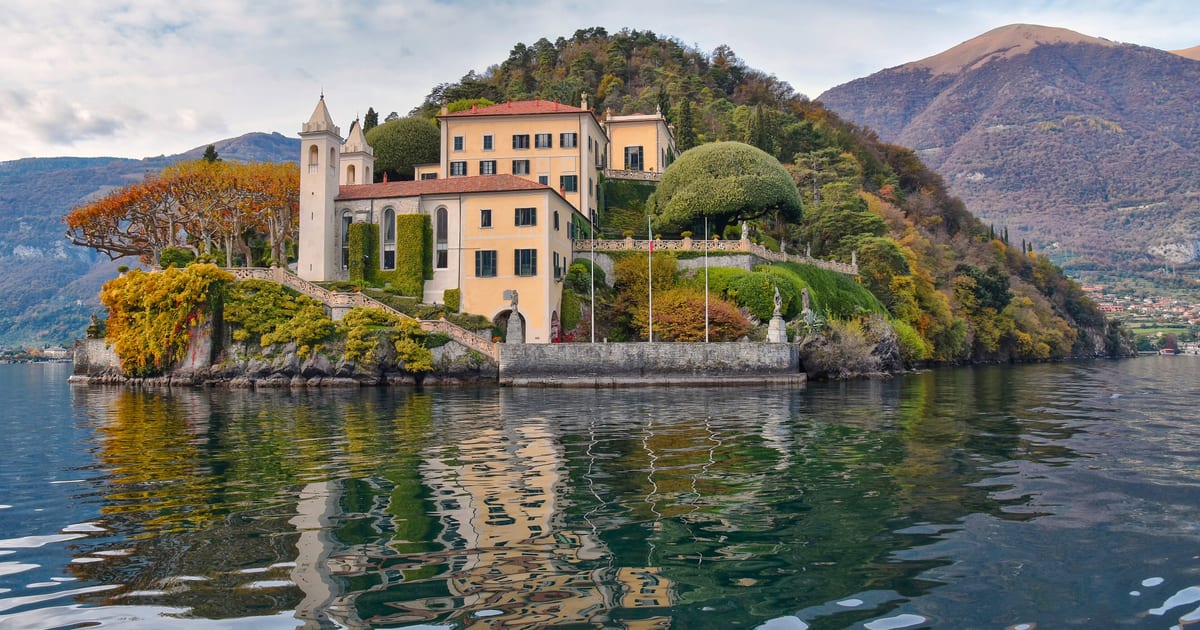
The villa stands on the Dosso di Lavedo, a wooded promontory on the western shore of Lake Como at Lenno, in the municipality of Tremezzina. It lies about 1.5 km east of Isola Comacina. Long before anyone built a summer house here, the point belonged to the Franciscans. A convent stood on the promontory from the 13th century.
Little of it survives. The two towers you see on the point are what remains of the convent's church. They are older than the villa by several centuries. When you walk the garden, look up at them: they are the only visible link to the friars, and the easiest part of the story to miss if you head straight for the house.
The published sources say little about daily life in the convent or how it came to an end. If the subject interests you, ask your guide. It is a good question to have ready while you wait for your tour to start.
Today you reach the point on foot from Lenno, about 1 km and roughly 25 minutes uphill, partly on gravel, or by taxi boat from the Lido di Lenno. Arriving by water lets you see the whole promontory before you set foot on it. That helps later, when you come to place the towers, the loggia and the villa in relation to each other.
Cardinal Durini builds a summer villa
The modern story begins with Cardinal Angelo Maria Durini, who bought the property in 1785. Two years later, in 1787, he made it a summer villa. FAI dates his work simply to the end of the eighteenth century, and both dates sit comfortably inside that description.
Durini's lasting addition was the loggia. He set it to take in views of both arms of the lake. It is an arched gallery, now covered in creeping fig (Ficus repens), with a wind rose inlaid in its floor. It still carries his name: the Loggia Durini.
You visit the loggia at your own pace, as part of the self-guided garden visit included with the tour ticket. It is reached by stairs. Look down at the floor before you look out at the water. The wind rose is easy to walk straight across without noticing.
Durini's decisions set the frame for everyone who came after him. The loggia survived every change of owner. Arconati Visconti improved it, and Monzino later gave it his Music Room and Library. More than two centuries on, it is still the part of the property that carries the cardinal's name.
Porro Lambertenghi, the patriots and Silvio Pellico
After 1796 the villa passed to Durini's nephew, Luigi Porro Lambertenghi. Under him it became more than a summer house. Patriots met here, and the quiet point at Lenno found itself part of the political story of its time.
Silvio Pellico was part of the household too. He tutored Porro Lambertenghi's sons. In 1820 Pellico was arrested by Austria. It is the best-known episode in the villa's nineteenth-century history, and it shows how far the conversations held on this promontory reached beyond the lake.
There is a small reminder in Lenno itself. Via Silvio Pellico is one of the streets where visitors park before walking up to the villa. Plenty of people pass the name on their way in without knowing the connection.
This chapter is about people rather than objects. The sources do not say which, if any, of the furnishings date from the Porro Lambertenghi years, so treat it as background for the rooms you will see. If you want to know more, it is a fair question for your guide.
Arconati Visconti, Marie Peyrat and Butler Ames
The villa was later sold to Giuseppe Arconati Visconti. His contribution was to the setting rather than the rooms. He improved the garden and the loggia that Durini had built, so the garden you walk today owes something to him as well as to the cardinal.
FAI names two more owners before the modern era: Marie Peyrat and the American general Butler Ames. Ames bought the villa in 1919. The sources say little about how either of them lived here, so we will not embroider their part of the story.
Put together, the sequence runs like this. A convent from the 13th century. Durini from 1785. Porro Lambertenghi after 1796. Then Arconati Visconti, Marie Peyrat, and Butler Ames from 1919. Guido Monzino from 1974, and FAI from 1988. Keep that order in mind and the rooms on the tour make more sense.
Butler Ames's purchase in 1919 carried the villa into the twentieth century. His was the last change of ownership before Monzino, who bought the house 55 years later and gave the interiors the character you see now.
Count Guido Monzino, the explorer
The last private owner shaped the house more than anyone since Durini. Count Guido Monzino, born in 1928, bought the villa in 1974. By then he had already led major expeditions, and the house became the place where he kept the record of that life.
Two expeditions frame his reputation. In 1971 he made a sledge expedition from Cape Columbia to the North Pole. In 1973 he led the first Italian expedition to climb Everest. Both are present in the villa, most directly in the collection he arranged in the attic.
Monzino was also a collector well beyond polar material. His books and maps formed collections of their own, and he filled the rooms with furniture and art. Expedition gear in the same house as eighteenth-century French furniture: that pairing is what sets these interiors apart from other lake villas.
The thread through the house is ice and altitude. The Library in the loggia holds his books on mountaineering and geography; the attic holds the Arctic material. You do not need to know anything about expeditions to follow it. The objects he kept make the scale of what he did plain enough.
What Monzino collected
Inside, the villa holds 18th-century French furniture, non-European art, silver, ceramics, painted glass and Beauvais tapestries. The mix is personal rather than period-correct. It reflects one owner's travels and tastes, not a single century.
The attic holds the Museum of Expeditions. Its collection of Inuit ivories is the largest outside Greenland. Beside it is the sledge used on the 1971 North Pole expedition, a plain working object in a house full of fine things.
Monzino also gave the loggia a new use. Durini built it for the view; Monzino put his Music Room and his Library there. The Library holds his books on mountaineering and geography, part of the wider collection of maps and books he assembled over his life.
If one room matters most to you, mention it to your guide at the start. Tours are small, and a specific question is easy to answer.
The bequest to FAI
Monzino died in 1988. He left the villa, most of the promontory and an endowment to FAI, which has run the property ever since. The endowment is the detail people overlook. He left the means to look after the place, not only the place itself.
That is why the collections are still in the house rather than dispersed. The furniture, the tapestries, the ivories and the sledge remain in the house, and the garden is maintained alongside them.
It also explains how the visit works today. The interiors are shown only on guided tours of up to 16 people, and booking is mandatory. Larger parties are split into separate groups, with at least 15 minutes between them.
FAI has now cared for the villa for more than three decades. Its own pages on the property are the best primary source for the rooms and the garden, and we list them with our other sources at the foot of this guide.
The garden: topiary, terraces and the umbrella oak
The garden is the work of several owners, and it shows. Expect dramatic topiary, paths lined with statues and panoramic terraces over the water. The best-known tree is a large holm oak pruned into the shape of an umbrella. Find it early; it makes a useful landmark when you are working out the paths.
Your booked time is your entry time to the garden, not the start of the tour. The ticket office gives you your tour time when your ticket is validated, and the wait can be up to 60 minutes. Use it well. Walk to the towers, climb to the Loggia Durini and look for the wind rose before you go indoors.
The villa has also had a career on screen. It was a location for A Month by the Lake (1995), for the lake retreat scenes in Star Wars: Episode II – Attack of the Clones (2002) and for Casino Royale (2006). FAI itself refers to the film areas of the garden.
Durini and Arconati Visconti meet at the loggia. Its arches are covered in creeping fig, and it was added to take in views of both arms of the lake. Pause there before your tour. It is the one spot where the cardinal's villa and the later garden come together.
Seeing the history on the guided tour
The ticket we book covers a guided tour of the villa's interiors, lasting about 50 minutes, in Italian or English. It also includes a self-guided visit of the garden, the terraces and the Loggia Durini. The interiors are where Monzino's story lives, so the guided tour is the part of the visit that carries the history.
The villa spreads over six levels, and the lift serves three of them. The Loggia Durini is reached by stairs. If anyone in your party has reduced mobility, contact the villa's staff in advance. Photography rules inside the house are not published, so ask your guide before you take pictures.
We book adult tickets (19 and over), tickets for ages 6–18, student tickets for ages 19–25 and a family ticket for two adults and two or more of their children aged 6–18. Children aged 0–5 go free and are added to your booking at no charge. We email your e-ticket once the booking is made. The guided tours fill days ahead, even in late October, so settle your date early.
Timing is firm. Entry is only on the date and at the time booked. Arrive more than 30 minutes early and you will be asked to wait; arrive late and the visit is not guaranteed. Dates cannot be changed and tickets are non-refundable. Allow about 25 minutes for the uphill walk from Lenno.
Frequently asked
When was Villa del Balbianello built?
The villa dates from 1787, when Cardinal Angelo Maria Durini, who bought the property in 1785, made it his summer residence. The site is older: a Franciscan convent stood on the point from the 13th century, and the two towers of its church survive.
Who owned Villa del Balbianello?
In order: Cardinal Durini, his nephew Luigi Porro Lambertenghi, Giuseppe Arconati Visconti, Marie Peyrat, the American general Butler Ames from 1919, and Count Guido Monzino from 1974. Monzino left it to FAI on his death in 1988.
Who was Guido Monzino?
Count Guido Monzino (1928–1988) was an explorer and collector. He made a sledge expedition from Cape Columbia to the North Pole in 1971 and led the first Italian expedition to climb Everest in 1973. He bought the villa in 1974.
What is the Museum of Expeditions?
It is Monzino's collection in the villa's attic. It holds the largest collection of Inuit ivories outside Greenland and the sledge used on his 1971 North Pole expedition. The villa's interiors are seen on the guided tour.
Who owns Villa del Balbianello today?
FAI has owned and run the villa since 1988. Guido Monzino left it the villa, most of the promontory and an endowment to care for them.
Which films were shot at Villa del Balbianello?
The villa was a location for A Month by the Lake (1995), the lake retreat scenes of Star Wars: Episode II – Attack of the Clones (2002) and Casino Royale (2006).
Is the guided tour available in English?
Yes. The guided tour of the interiors runs in Italian or English and lasts about 50 minutes, with up to 16 people per group. The garden, terraces and Loggia Durini are visited at your own pace.